B-dur

_major_chord_for_guitar.svg)
B-dur – tonacja muzyczna, która oparta jest na skali durowej. Jej toniką jest b[a].
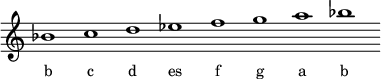
Gama B-dur zawiera dźwięki: b, c, d, es, f, g, a. Tonacja B-dur zawiera dwa bemole.
|
Gama B-dur zapisana za pomocą |
 |
|
Gama B-dur zapisana za pomocą |
 |
Pokrewną jej molową tonacją równoległą jest g-moll[1], jednoimienną molową – b-moll.
B-dur to także akord, zbudowany z pierwszego (b), trzeciego (d) i piątego (f) stopnia gamy B-dur.
|
Akord B-dur |
 |


Znane dzieła w tonacji B-dur:
- Wolfgang Amadeus Mozart – serenada Gran Partita (KV 361)
- Ludwig van Beethoven – IV Symfonia, Kwartet nr 13 i Wielka Fuga na kwartet smyczkowy
- George Gershwin – Solo na klarnecie otwierające Błękitną Rapsodię
- Siergiej Prokofjew – Suita Scytyjska
- Giuseppe Verdi – Powrót Radamesa z Aidy
- Johannes Brahms – II Koncert fortepianowy
Zobacz też
Uwagi
- ↑ Nazewnictwo dźwięku b jest różne w różnych krajach, co może prowadzić do nieporozumień.
Częstotliwość Nazwa polskojęzyczna Nazwa angielskojęzyczna 493,883 Hz H B 466,164 Hz b Bes, B♭, B flat W polskojęzycznej Wikipedii stosowane są nazwy polskie.
Przypisy
- ↑ Franciszek Wesołowski, Zasady muzyki, wyd. 7, Kraków: Polskie Wydawnictwo Muzyczne, 1986, s. 127, ISBN 83-224-0250-3.
Linki zewnętrzne
- B♭ major scale. [w:] WolframAlpha Computational Knowledge Engine [on-line]. Wolfram Alpha LLC — A Wolfram Research Company. [dostęp 2018-07-07]. (ang.).
- B♭ major chord. [w:] WolframAlpha Computational Knowledge Engine [on-line]. Wolfram Alpha LLC — A Wolfram Research Company. [dostęp 2018-07-07]. (ang.).

Content Disclaimer
Informasi ini disarikan dari Wikipedia dan disajikan kembali untuk tujuan edukasi. Konten tersedia di bawah lisensi CC BY-SA 3.0. Kami tidak bertanggung jawab atas ketidakakuratan data yang bersumber dari kontribusi publik tersebut.
- The information displayed on this website is sourced in part or in whole from Wikipedia and has been adapted for the purpose of restating it. We strive to provide accurate and relevant information, however:
- There is no guarantee of absolute accuracy. Wikipedia is an open, collaborative project that can be edited by anyone, so information is subject to change.
- It is not intended to constitute professional advice. The content displayed is for informational and educational purposes only. For important decisions (e.g., medical, legal, or financial), please consult a professional.
- Content copyright. Wikipedia is licensed under the Creative Commons Attribution-ShareAlike License (CC BY-SA). This means that content may be reused with appropriate attribution and shared under a similar license.
- Responsible use. Any risk arising from the use of information from this website is entirely the responsibility of the user.