Namu
 Atol Namu na zdjęciu NASA z 1999 roku | |
| Państwo | |
|---|---|
| Akwen | |
| Powierzchnia |
6,27 km² |
| Populacja (2011) • liczba ludności |
|
Położenie na mapie Wysp Marshalla 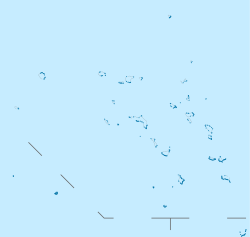 | |
Położenie na mapie Oceanii 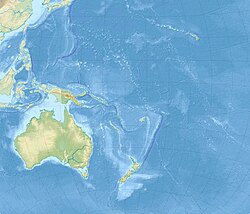 | |
 7°59′00″N 168°10′25″E/7,983333 168,173611 7°59′00″N 168°10′25″E/7,983333 168,173611
| |


Namu (j. marsz: Namo[1]) – zamieszkany atol na Wyspach Marshalla na Oceanie Spokojnym. Należy do łańcucha wysp Ralik Chain. Według danych za rok 2011 atol zamieszkiwało łącznie 780 osób (spadek w stosunku do 1999 roku, kiedy to liczba ta wynosiła 903), na wyspach znajdowało się 136 domów[2]. Zlokalizowane jest tu także lotnisko (kod IATA: NMU)[3].
Atol został odkryty przez Álvara de Mendañę w 1568[4].
Geografia
Namu należy do łańcucha wysp Ralik Chain, leży 62 km na południowy wschód od atolu Kwajalein, 45 km na północny zachód od Ailinglapalap i 65 km na południowy zachód od wyspy Lib. Składa się z 51 wysp (według innego źródła wysp jest 54[5]) o łącznej powierzchni 6,27 km². Łączna powierzchnia laguny wynosi 397,64 km²[1]. Namu ma długość około 60 km, a szerokość waha się między 11 km na południu, 4 km w środkowej części i 21 km na północy[6]. W przeszłości atol określano nazwami: Bond, Magaretha Islands, Margaretta, Musquillo, Mussekett, Nemu i Ross[1].
Na atolu uprawiane są następujące rośliny: pandany, kokosy, chlebowce, banany i dynie[7]. Ponadto spotkać można następujące gatunki roślin: Alocasia macrorrhizos, Asclepias curassavica, Colocasia esculenta, Crinum asiaticum, Eleusine indica, Eragrostis amabilis i Ipomoea violacea[8]. W 1967 r. stwierdzono występowanie na Namu 6 gatunków ptaków, w tym 1 lęgowego (Anous tenuirostris) i 5 potencjalnie lęgowych[9].
Przypisy
- ↑ a b c Atoll Information--Namu Atoll (Marshall Islands). marshalls digital micronesia, 1998-05. [dostęp 2016-07-28]. (ang.).
- ↑ Economic Policy, Planning, and Statistics Office, Office of the President: The RMI 2011 Census of Population and Housing. Summary and Highlights Only. U.S. Department of the Interior, 2012-02-14. [dostęp 2016-07-28]. [zarchiwizowane z tego adresu]. (ang.).
- ↑ NMU - Namu, MH - Airport - Great Circle Mapper. Great Circle Mapper. [dostęp 2016-07-28]. (ang.).
- ↑ Max Quanchi, John Robson: Historical Dictionary of the Discovery and Exploration of the Pacific Islands. Lanham, Maryland; Toronto; Oxford: The Scarecrow Press, Inc., 2005, s. XIX. ISBN 0-8108-5395-7.
- ↑ Republic of the Marshall Islands - Namu Atoll. Republic of the Marshall Islands Embassy, USA, 2002. [dostęp 2016-07-28]. (ang.).
- ↑ Marshall Islands - Namu. the island encyklopedia. [dostęp 2016-07-28]. (ang.).
- ↑ Nancy J. Pollock: Namu Atoll revisited: A follow-up study of 25 years of resource use. National Museum of Natural History, Smithsonian Institute, Washington D.C, U.S.A., 1996-04. [dostęp 2016-07-28]. (ang.).
- ↑ Plant Threats to Pacific Ecosystems: Utirik (Utrik, Utrõk) Atoll. Hawaiian Ecosystems at Risk project, 1998-05. [dostęp 2016-08-01]. (ang.).
- ↑ A. Binion Amerson Jr.: Atoll Research Bulletin No. 127: Ornitology of the Marshall and Gilbert Islands. Waszyngton, U.S.A.: The Smithsonian Institute, 1969, s. 168–170.
Linki zewnętrzne
- Atoll information--Namu Atoll (Marshall Islands) – Map from 1881. marshalls digital micronesia. [dostęp 2016-07-28]. (ang.).
| Ratak Chain („Wschód Słońca”, Wschodnie) | |
|---|---|
| Ralik Chain („Zachód Słońca”, Zachodnie) |

Content Disclaimer
Informasi ini disarikan dari Wikipedia dan disajikan kembali untuk tujuan edukasi. Konten tersedia di bawah lisensi CC BY-SA 3.0. Kami tidak bertanggung jawab atas ketidakakuratan data yang bersumber dari kontribusi publik tersebut.
- The information displayed on this website is sourced in part or in whole from Wikipedia and has been adapted for the purpose of restating it. We strive to provide accurate and relevant information, however:
- There is no guarantee of absolute accuracy. Wikipedia is an open, collaborative project that can be edited by anyone, so information is subject to change.
- It is not intended to constitute professional advice. The content displayed is for informational and educational purposes only. For important decisions (e.g., medical, legal, or financial), please consult a professional.
- Content copyright. Wikipedia is licensed under the Creative Commons Attribution-ShareAlike License (CC BY-SA). This means that content may be reused with appropriate attribution and shared under a similar license.
- Responsible use. Any risk arising from the use of information from this website is entirely the responsibility of the user.