Dżul

| Układ | |
|---|---|
| Wymiar |
|
| Jednostka | |
| Typowe symbole wielkości |
W, E, Q |
| w jednostkach SI |
|
| w jednostkach CGS |
|
| w jednostkach anglosaskich |
|
| Źródło nazwy |
![{\displaystyle \left[\mathrm {\frac {kg\cdot m^{2}}{s^{2}}} \right]}](https://wikimedia.org/api/rest_v1/media/math/render/svg/151307b626d3565888ef54852ab96b170b582259)
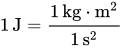
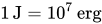

Dżul (J) (ang. Joule) – jednostka pracy i energii – w tym ciepła – w układzie SI[1]. Jeden dżul to praca wykonana przez siłę o wartości 1 N przy przesunięciu punktu przyłożenia siły o 1 m w kierunku równoległym do kierunku działania siły[2]
- 1 J = 1 N·m.
Związek z mocą:
Nazwa dżul pochodzi od nazwiska angielskiego fizyka Jamesa Joule’a.
Przeliczenie 1 dżula na inne jednostki pracy, energii i ciepła:
- kaloria (cal), 1 J = 0,238846 cal,
- erg, 1 J = 107 erg,
- elektronowolt (eV), 1 J = 0,62415×10¹⁹ eV,
- kilogramometr (kGm), 1 J = 0,10197 kGm,
- kilowatogodzina (kWh), 1 J = 1/3600000 kWh ≈ 0,278×10−6 kWh.
Dżul a niutonometr
Jednostką momentu siły jest N · m. Iloczyn niutona i metra to w układzie SI dżul, jednak – aby nie wprowadzać nieporozumień – jednostkę momentu siły nazwano niutonometrem (N · m) i nie zastępuje się jej dżulem.
Problem ten wiąże się z tym, że praca definiowana jest jako iloczyn skalarny siły i przemieszczenia, natomiast moment siły to iloczyn wektorowy siły i ramienia.
Wielokrotności i podwielokrotności jednostki (wyróżniono najczęściej używane):
| Wielokrotności | Podwielokrotności | |||||
|---|---|---|---|---|---|---|
| Przedrostek | Nazwa | Symbol | Przedrostek | Nazwa | Symbol | |
| 100 | dżul | J | ||||
| 101 | dekadżul | daJ | 10−1 | decydżul | dJ | |
| 102 | hektodżul | hJ | 10−2 | centydżul | cJ | |
| 103 | kilodżul | kJ | 10−3 | milidżul | mJ | |
| 106 | megadżul | MJ | 10−6 | mikrodżul | µJ | |
| 109 | gigadżul | GJ | 10−9 | nanodżul | nJ | |
| 1012 | teradżul | TJ | 10−12 | pikodżul | pJ | |
| 1015 | petadżul | PJ | 10−15 | femtodżul | fJ | |
| 1018 | eksadżul | EJ | 10−18 | attodżul | aJ | |
| 1021 | zettadżul | ZJ | 10−21 | zeptodżul | zJ | |
| 1024 | jottadżul | YJ | 10−24 | joktodżul | yJ | |
Zobacz też

Przypisy
- ↑ dżul, [w:] Encyklopedia PWN [online], Wydawnictwo Naukowe PWN [dostęp 2021-10-15].
- ↑ Leksykon naukowo-techniczny z suplementem. Warszawa: WNT, 1989. ISBN 83-204-0967-5.
| jednostki podstawowe |
| ||||||
|---|---|---|---|---|---|---|---|
| jednostki pochodne z osobnymi nazwami |
| ||||||
| inne jednostki pochodne |
| ||||||
| przedrostki (prefiksy) |
| ||||||
| przepisy i instytucje |
| ||||||
| powiązane nauki |

graf skierowany
związków definicyjnych
| SI |
| ||||
|---|---|---|---|---|---|
| CGS | |||||
| inne metryczne |
| ||||
| naturalne |
| ||||
| inne używane głównie w fizyce |
| ||||
| paliwowe |
| ||||
| inne |
| ||||
| uczeni według daty narodzin |
|
definicja pracy –
wielkości definiującej energię

Content Disclaimer
Informasi ini disarikan dari Wikipedia dan disajikan kembali untuk tujuan edukasi. Konten tersedia di bawah lisensi CC BY-SA 3.0. Kami tidak bertanggung jawab atas ketidakakuratan data yang bersumber dari kontribusi publik tersebut.
- The information displayed on this website is sourced in part or in whole from Wikipedia and has been adapted for the purpose of restating it. We strive to provide accurate and relevant information, however:
- There is no guarantee of absolute accuracy. Wikipedia is an open, collaborative project that can be edited by anyone, so information is subject to change.
- It is not intended to constitute professional advice. The content displayed is for informational and educational purposes only. For important decisions (e.g., medical, legal, or financial), please consult a professional.
- Content copyright. Wikipedia is licensed under the Creative Commons Attribution-ShareAlike License (CC BY-SA). This means that content may be reused with appropriate attribution and shared under a similar license.
- Responsible use. Any risk arising from the use of information from this website is entirely the responsibility of the user.